Palmetto
BioGas
Renewable Energy Solution
Charleston County's
Menu
Our Team has grown to include business consultants, legal counsel, engineers, and is embedded inside the growing biogas industry. We’ve researched the latest advancements in process controls, environmental safety, and biogas upgrading. With proper planning, a well designed facility, optimized for local operations and resources can be tailored to meet Charleston County’s organic waste challenges, while providing a more environmentally-friendly energy source.
The idea for this project originated from research about the process of methanogenesis, which is the microbial production of methane.
I transitioned from studying methane emissions in the local environment to anaerobic digestion (AD). With a firm understanding of the science, and a desire to bring technological innovation to the biogas industry, Palmetto BioGas was formed. Support comes from our strategic Partners towards a clean, safe, fully-funded biogas production facility (the Charleston Bioenergy Recovery Facility), which will be built to help reduce GHG emissions and contribute to a circular economy involving cleaner, cheaper fuel.

Sullivans Island, entrance to Charleston Harbor. Photo Credit. Agon (RIT)
I grew up with my mom and dad, an older sister, and a twin brother. My childhood was care-free and very pleasant. I grew up on Sullivan's Island, with plenty of exposure to the local beaches and outdoor activities . I was (and still am) independent, like exploring places, and am continually curious about new ideas.
As my fondness and appreciation of nature grew, I inherited my family's sustainable practices (which we didn't know the term was called sustainability at the time). We recycled, didn't waste things and reused them. I hated to see trash on/off the road when I was a kid- I couldn't understand why people would trash their own community or natural settings
Hiking in the Foothills, upstate SC.

Walking the Ravanel bridge at Sunrise.
I first attended Trident Technical College while living on the East side of downtown Charleston, then transferred to College of Charleston- originally applying for a major in biology with minors in project management and Spanish, but quickly became enamored with molecular biology, and passionate about environmental chemistry and sustainability.
Key moments for me during this time were:
- visiting Earthaven, a sustainable eco-village in Western North Carolina for course credit
- Serving as Project Implementation Lead for the Center for Sustainable Development at CofC
- Obtaining a rewarding research experience with the NCCOS and ORISE
- Taking a graduate-level genomics course, which lead me to branch into data analysis and computing.

With a friend for
CofC's 250th anniversary!
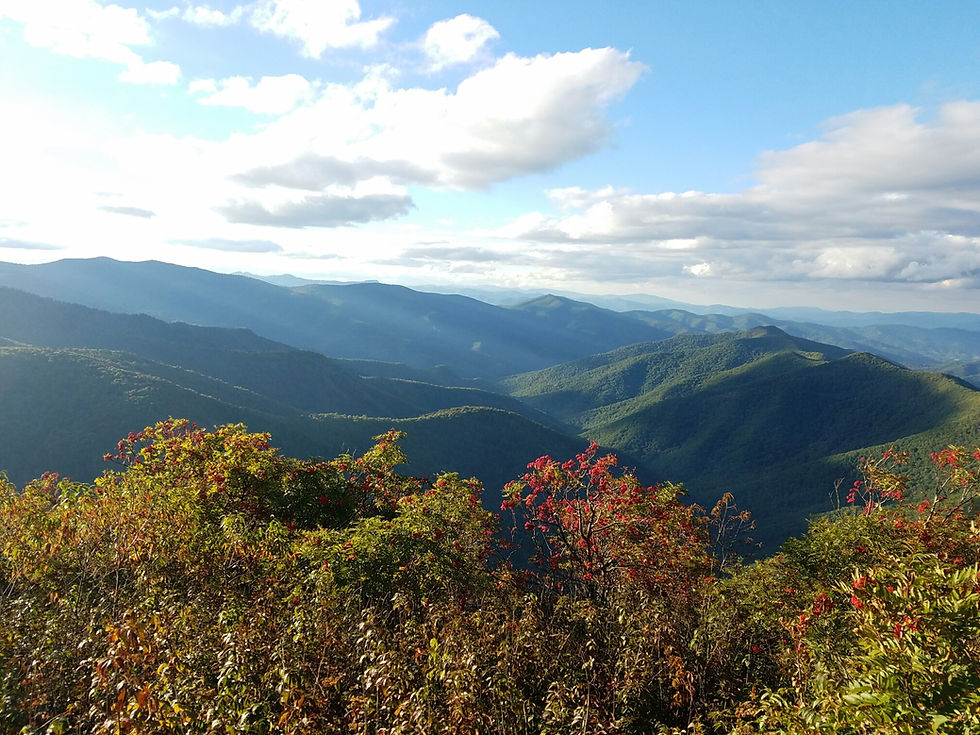
Earthaven is nestled in Appalachia's Blue Ridge Mountains. Photo credit: Caroline Rose

After undergraduate college, I enrolled in a master's program in bioinformatics at Rochester Institute of Technology in Rochester, NY. While I was there I worked on many academic projects, some supported by federal grants, but also had fun with friends!
In New York, they have supportive policy for the environment stewardship (e.g. NY2PI) and clean energy, and I began to become increasingly interested in entrepreneurialism, since the private sector tends to move faster in terms of innovation and implementation than the public sector. However, the ideal strategy is a synergistic collaboration among academia, industry, AND government.

Whitewater rafting on the Gennesee River at Letchworth State Park ("the Grand Canyon of the East"). From front to back is my business partner, a friend, a research collaborator, and then yours truly, steering.
Kiteboarding at Woodlawn Beach (Buffalo, NY). In the background you can see windmills. There are a lot in upstate and western NY, located around the Great Lakes and Finger Lakes region.

In late 2025, I moved back to Charleston, and began studying microbes in Charleston, linking methane emissions to environmental chemistry, but quickly transitioned into industrial research of anaerobic digestion.
In 2026, the Palmetto BioGas was formed and registered with the State Secretary. Discussions began immediately with Charleston County, the Charleston Water System, and Dominion Energy.
2027 will be a year of research and development, as well as a feasibility study and techno-economic analysis to be performed in collaboration with the Department of Energy.

Palmetto BioGas
Lowcountry ecological sites that I studied included the coast, salt marshes in the inner harbor and along the Ashley River, and the fresh water Ion Swamp in the Francis Marion Forest.
is excited to contribute to local energy security and environmental stewardship.
The 250th anniversary of Independence Day at Sullivans Island, with the newly installed Palmetto Fort at the top of the park hill.